Best AI Tools for Physiotherapy Students in 2026: Apps, Websites & Clinical Learning Resources
Choosing the best AI tools for physiotherapy students starts with the task you want to practise, not the most impressive chatbot response. This guide compares verified options for revision, simulated assessments, OSCE preparation, SOAP notes and NHS Band 5 interviews, with practical prompts and clear limits for students and newly qualified physiotherapists.
Updated · Educational content update; use the cited sources alongside local guidance and supervision.
Which are the best AI tools for physiotherapy students?
Choose by learning task: ChatGPT suits guided explanations, NotebookLM suits revision from supplied sources, and Physiotutors ChatCPG suits guideline exploration. Geeky Medics offers conversational virtual patients; PhysioAI advertises physiotherapy-specific, choice-based cases with waitlist access. Physio Pearls AI Clinical Lab offers structured fictional reasoning, documentation, OSCE and interview activities. These are best-fit options, not rankings.
Disclosure: This article is published by Physio Pearls, which operates the AI Clinical Lab included below. External capabilities and prices are advertised on official pages reviewed on 19 November 2026, not hands-on reviews or independent tests. Only one live SOAP Notes Studio activity was checked.
| Tool | Best-fit purpose | Distinctive features | Important limitation | Verified pricing or access |
|---|---|---|---|---|
| ChatGPT | Guided revision | Study mode questions, explanations and knowledge checks | Can make mistakes; no physiotherapy-specific validation established | Study mode announced for logged-in Free, Plus, Pro and Team users; Pro tiers listed at $100, $200 or $500/month |
| Physiotutors ChatCPG | Guideline exploration | Physiotherapy guidelines, consensus statements and resource links | Not an OSCE simulator; check primary guidance | Included with Physiotutors membership; numeric membership price unconfirmed |
| NotebookLM / Gemini Notebook | Source-grounded studying | Cited answers, flashcards and quizzes from supplied sources | Source quality and currency still matter | No-charge personal signup; qualifying education access and paid higher-limit routes |
| Geeky Medics AI Virtual Patients | Consultation rehearsal | Advertised 900+ virtual patients, text/voice and AI feedback | Physiotherapy-specific station library not established | OSCE Stations including virtual patients: £44.99/year, annual auto-renewal |
| PhysioAI Practice Room | Physiotherapy case decisions | Advertised 85+ fictional MSK/cardiorespiratory cases and four-choice turns | Waitlist; feedback not established as validated marking | Student Clinical OS: ₹299/month; separate Practice Room/Pro price unclear |
| Physio Pearls AI Clinical Lab | Structured fictional practice | Five bounded activities, criteria feedback and saved attempts | Formative scoring, not official assessment | Signed-in Free, PRO and Lifetime access; prepaid packs: 20 credits £4.99 or 50 credits £9.99 |
Table sources: OpenAI Study mode and Pro tiers; Physiotutors ChatCPG; Google plan access; Geeky Medics access and pricing; PhysioAI Practice Room and pricing; Physio Pearls AI Clinical Lab. Prices are reference figures; confirm regional availability, inclusions and tax-inclusive checkout totals.
Prefer structured practice? Explore AI Clinical Lab before spending credits.
Study from sources with ChatGPT, ChatCPG and NotebookLM
ChatGPT for physiotherapy: OpenAI advertises Study mode as step-by-step learning with guiding questions, hints, scaffolded explanations and knowledge checks. Consider it for anatomy or biomechanics revision, not validated physiotherapy teaching. OpenAI says it can behave inconsistently and make mistakes. See the official Study mode announcement.
Study prompt: “Using only this approved lecture extract, ask me one question at a time about how a muscle's moment arm affects joint torque. Wait for my answer, explain any misunderstanding, and identify anything the extract does not establish.” Answer before asking for help.
Physiotutors ChatCPG: Its official pages advertise exploration of physiotherapy clinical practice guidelines and consensus statements across MSK, neurology and cardiopulmonary topics. Use its guideline and educational-resource links to check the original recommendation, population and date. See the product description and prompting guide.
Fictional case prompt: “For an invented adult with shoulder symptoms, compare assessment considerations in the guideline you identify. State its date, relevant population, recommendation strength if reported, and information still needed. Do not create a patient-specific treatment prescription.” Membership inclusion does not establish standalone free access.
NotebookLM, now Gemini Notebook: Google advertises cited answers, study guides, flashcards and practice quizzes from uploaded sources, alongside Guided Learning. Use it to organise approved material, not generate an entire syllabus. See Google's education overview.
Source-grounded prompt: “From these two approved lecture documents, make five questions comparing concentric and eccentric muscle actions. Cite the passage supporting each answer and flag disagreements without resolving them by invention.” Open the cited passages yourself: grounding does not make an outdated source current. Google's Workspace overview says chat history is not currently retained, so save useful responses as notes.
Use virtual patients for OSCE communication practice
Geeky Medics AI Virtual Patients advertises text and voice interaction, multilingual support, custom scenarios and instant AI-examiner feedback. Its institutional SimChat offering also advertises video scenarios and cohort analytics. No physiotherapy-specific station library was established; consider it for consultation rehearsal rather than a complete practical syllabus. See the virtual-patient platform and SimChat overview.
PhysioAI Practice Room advertises fictional MSK and cardiorespiratory patients with four-choice history, examination, red-flag and treatment-planning turns. It describes decision feedback and saved history. Access opens in waves through a waitlist; free accounts receive one draw of two patients after access. Feedback is advertised, not independently validated marking. See the official Practice Room page.
Fictional rehearsal brief: “An invented adult is worried that shoulder pain will prevent a return to swimming. Practise asking about their concerns, explain the purpose of an assessment in plain language, and check understanding without promising a diagnosis or recovery date.” Use custom scenarios where available, or a partner.
The Lab's OSCE mode uses typed dialogue and actions, including timed exam practice. None of these formats demonstrates your palpation, handling, movement assessment or treatment delivery. Pair digital rehearsal with observed practical practice and your university's criteria; revisit our physiotherapy OSCE preparation guide for the wider preparation framework.
Practise assessment reasoning, differentials and SOAP notes
Use AI clinical reasoning tools to examine your thinking, not supply the correct diagnosis. Separate fictional facts, hypotheses, missing information and safety concerns; fluent differentials can contain unsupported assumptions.
Fictional reasoning prompt: “An invented runner reports gradual knee discomfort after increasing training; examination and screening findings have not been supplied. Suggest three hypotheses to investigate, what would support or weaken each, and what information is missing. Do not invent normal screening results or recommend treatment.” Check against approved teaching, not as clinical advice.
In the Physio Pearls AI Clinical Lab, Clinical Detective constrains fictional case exploration, while Clinical Reasoning X-Ray represents controlled links between evidence and hypotheses. Despite its name, X-Ray is not radiograph analysis. Both make available information explicit.
For documentation, write your own note before requesting feedback. Fictional SOAP prompt: “Facts: an invented adult reports right shoulder discomfort when reaching; active flexion is recorded as 120 degrees; no other findings or treatment are supplied. Review my draft for source fidelity, laterality, separation of observation from interpretation and unsupported additions. Do not fill gaps or claim a safety screen was completed.”
SOAP Notes Studio evaluates submitted fictional notes rather than documenting a real consultation. Use feedback to revise your own work, then compare with our SOAP notes guide and your course expectations. For safety context, revisit red flags and referral principles; no chatbot response should decide a real patient's care.
Prepare NHS Band 5 interview answers without invented experience
AI can ask focused interview questions, but must not invent placements, achievements or outcomes. Start with the actual job advert and person specification, not supposedly universal panel questions.
The AI Clinical Lab's interview activity uses job-advert text or a PDF to support practice. Users check the extracted criteria and provide truthful evidence for their answers. Review uploaded documents first and remove private details; do not submit patient information or confidential employer material.
Interview prompt: “Using this public Band 5 person specification, ask one teamwork question. Wait for my answer, identify criteria I addressed and claims I need to evidence, then ask one follow-up. Do not invent an example, assign an official panel score or predict whether I will get the job.”
Practise aloud afterwards. If you lack a matching example, acknowledge the gap rather than inventing experience. Our Band 5 interview guide covers the broader preparation process without relying on AI.
Understand chatbot limits, privacy and academic integrity
Hallucinations: Chatbots can invent findings, citations or explanations. OpenAI acknowledges Study mode mistakes; source-grounded tools depend on the supplied material. Check important statements against current primary guidance and approved teaching.
The World Health Organization's AI guidance identifies simulated-patient education as a potential use, while warning about false, inaccurate, biased or incomplete outputs, automation bias and patient-information risks. This is not endorsement of any tool.
Inconsistent assessment: “Mark my OSCE” does not establish a stable rubric. None of the reviewed external pages establishes validated physiotherapy marking. Ask which criteria were used, what supports the feedback and what cannot be assessed.
Unstructured progression: An open chat does not necessarily provide a coherent syllabus or comparable attempts. Set one objective, attempt it unaided, check feedback and repeat against the same criteria. Structured practice is still not official assessment.
Privacy: Use invented cases, never patient information. Removing names is insufficient if dates, locations or distinctive circumstances remain identifiable. Check institutional rules and provider data settings before uploading material; protections vary by account and plan.
Academic integrity: Check the assessment's AI policy. Do not submit generated work as your own, fabricate references or upload restricted material. Record permitted assistance, then test yourself without AI: can you explain and justify your answer?
Explore Physio Pearls AI Clinical Lab
The Physio Pearls AI Clinical Lab is launched for signed-in Free, PRO and Lifetime users. Five bounded activities use fictional cases and explicit constraints:
Clinical Detective supports constrained exploration of a fictional case. Consider why each information request matters.
SOAP Notes Studio evaluates a submitted fictional note against the activity's supplied facts and criteria. It is not a real-patient note generator or clinical record system.
Clinical Reasoning X-Ray presents a controlled evidence-to-hypothesis graph. It does not interpret medical images.
OSCE practice and timed exam use typed dialogue and actions. This is not hands-on assessment, video examination or a live examiner panel.
Interview practice uses a job advert or PDF, user-checked criteria and truthful evidence. It provides practice, not recruitment decisions.
Feedback uses deterministic formative criteria and safety scoring, with bounded optional AI commentary. It is not official or validated AI grading, and a favourable score does not certify competence. A wallet, activity history and saved attempts support revisiting your work.
Access and costs: AI credits are separate from PRO, with no recurring AI plan. Production prepaid packs are 20 credits for £4.99 or 50 for £9.99. Clinical Detective, SOAP Notes Studio and Clinical Reasoning X-Ray cost one credit per activity; OSCE costs two per station. Targeted interview practice costs two credits for up to three questions including follow-ups; full practice costs ten for six main questions plus up to two follow-ups. An introductory Detective activity is free only for eligible users new to the Lab.
What was actually checked: One live SOAP activity used exactly one credit, saved its feedback and replayed without an additional charge. This check does not establish educational validity or a complete live payment test; no live pack purchase was completed for this comparison. Check the displayed cost before starting.
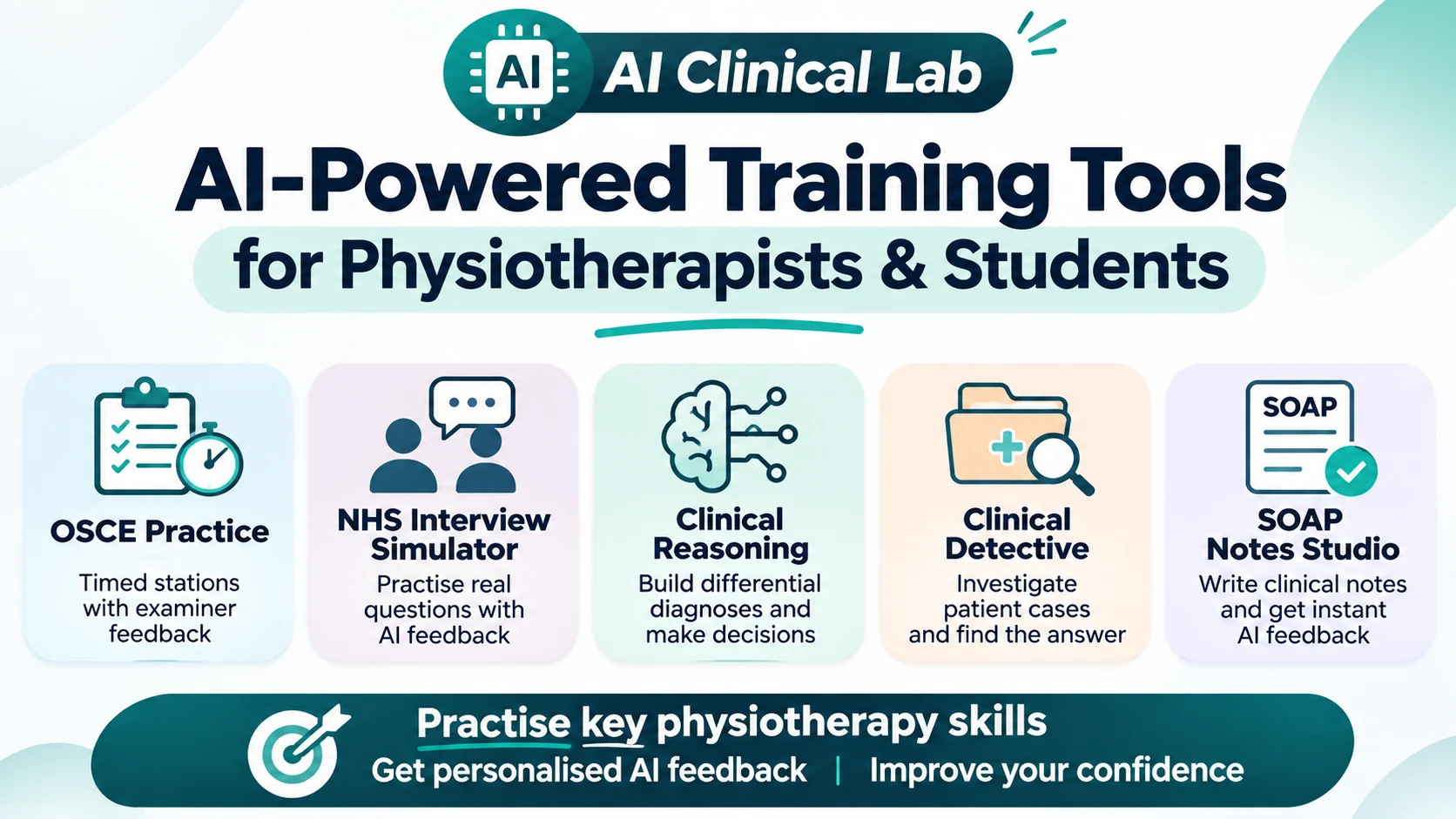 Educational illustration of the five Lab activities, not a live application screenshot.
Continue your learning
Connect AI practice to existing physiotherapy resources
Connect focused AI rehearsal to these existing learning routes and practical feedback.
Physiotherapy Student pathway
Find study and preparation routes for your learning goal.
Explore the Student pathwayOSCE Prep
Existing PRO checklist-led rehearsal, separate from Lab credits.
Explore OSCE Prep with PROCase Studies
Practise reasoning with the existing staged cases.
Open Case StudiesAI Clinical Lab
Review fictional activities, access and credit information.
Explore AI Clinical LabFrequently asked questions
What is the best AI tool for physiotherapy students?
There is no verified overall winner. Match the tool to guided revision, source-based studying, guideline exploration or fictional simulation, and check its limitations against your course requirements.
Can I use ChatGPT to study physiotherapy?
Use it as supplementary support. Study mode advertises guiding questions and knowledge checks but can make mistakes. Verify explanations; do not use outputs for diagnosis, prescribing or patient-care decisions.
Are any of these AI physiotherapy tools free?
There are limited no-charge routes: ChatGPT Free Study mode was announced; Google offers personal signup; ChatCPG is included with membership. The Lab has an eligibility-limited introductory Detective activity; other activities use separate credits.
Can AI virtual patients replace physiotherapy OSCE practice?
No. They supplement communication and fictional decisions but cannot establish hands-on competence. Use observed practical rehearsal and university criteria; advertised AI feedback is not validated physiotherapy assessment.
Can I upload placement notes for AI feedback?
Do not upload patient notes. Use entirely invented cases and check institutional rules before uploading other material. Removing names alone does not reliably remove identifying details.
Is Physio Pearls AI Clinical Lab included with PRO?
Free, PRO and Lifetime users can access the launched Lab, but activities use separate prepaid credits, not a recurring AI plan. Check costs before starting; scores are not official grades.
Evidence and professional guidance
Sources used for this guide
These sources informed this educational article. Local policy, the person’s needs and appropriate supervision remain the authority for clinical decisions.
- [1]OpenAI: Introducing study mode
- [2]OpenAI Help Center: About ChatGPT Pro tiers
- [3]Physiotutors: Introducing the AI Clinical Assistant / ChatCPG
- [4]Physiotutors: How to Effectively Use chatCPG
- [5]Google for Education: Gemini Notebook for Education
- [6]Google Help: Learn about Gemini Notebook's plans
- [7]Google Workspace: Gemini Notebook for business
- [8]Geeky Medics: Virtual Patients Platform
- [9]Geeky Medics: Virtual Patient Simulator / SimChat
- [10]PhysioAI: Patient Simulator / Practice Room
- [11]PhysioAI: Official pricing
- [12]Physio Pearls: AI Clinical Lab: activities, access and credits
- [13]WHO: WHO releases AI ethics and governance guidance for large multi-modal models
Recommended Resource
Choose your next fictional practice task
Check the activity boundaries and credit cost, then practise one fictional task. Use feedback for further study, not certification.
Explore Physio Pearls AI Clinical Lab